

Introduction
Modern communication infrastructure depends heavily on optical networks, where data is transmitted as light through optical fibers. At the heart of this technology lies the laser, a highly controlled and coherent light source that enables high-speed, long-distance, and reliable data transmission. Without lasers, today’s global internet, cloud computing, and telecommunications systems would not be possible.
Fundamentals of Laser Technology
A laser (Light Amplification by Stimulated Emission of Radiation) produces a narrow, coherent, and monochromatic beam of light. These properties make lasers ideal for optical communication systems because they allow precise control over signal transmission with minimal loss and interference.
Key characteristics of lasers used in optical networks include:
- High coherence – ensures signal integrity over long distances
- Narrow spectral width – supports dense wavelength multiplexing
- High intensity – enables transmission over thousands of kilometers
- Directional emission – allows efficient coupling into optical fibers
Laser Sources in Optical Networks
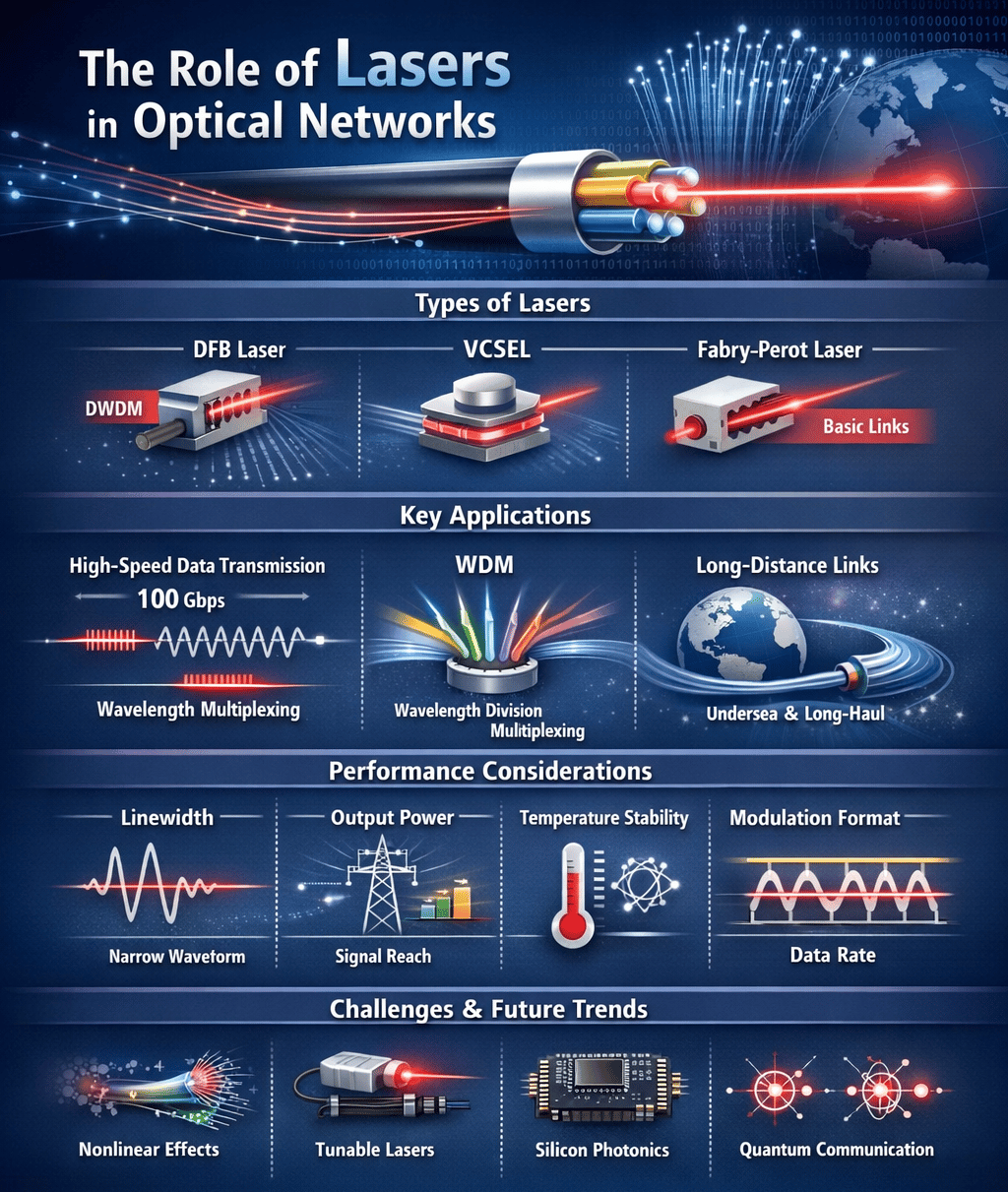
Different types of semiconductor lasers are used depending on the application and network requirements:
1. Distributed Feedback (DFB) Lasers
DFB lasers are widely used in long-haul and metropolitan networks due to their stable wavelength and narrow linewidth. They are essential for Dense Wavelength Division Multiplexing (DWDM) systems.
2. Vertical-Cavity Surface-Emitting Lasers (VCSELs)
VCSELs are commonly used in short-range communications such as data centers and local area networks. They are cost-effective, energy-efficient, and easy to integrate.
3. Fabry–Pérot Lasers
These lasers are simpler and less expensive but have broader spectral output, making them suitable for short-distance and lower-performance applications.
Role of Lasers in Optical Communication Systems
1. Optical Signal Generation
Lasers act as the primary source of light in optical transmitters. Electrical signals carrying data are converted into optical signals by modulating the laser output.
2. High-Speed Data Transmission
Lasers support extremely high data rates, reaching hundreds of gigabits per second and beyond. Advanced modulation formats (e.g., QAM, PAM-4) rely on laser stability and precision.
3. Wavelength Division Multiplexing (WDM)
Lasers enable multiple data channels to be transmitted simultaneously over a single fiber by using different wavelengths. This dramatically increases network capacity.
4. Long-Distance Communication
In long-haul systems, lasers combined with optical amplifiers allow signals to travel across continents and under oceans with minimal degradation.
5. Coherent Optical Communication
Modern networks use coherent detection techniques that require highly stable lasers. These systems improve spectral efficiency and resilience to noise and dispersion.
Performance Considerations
Several factors influence laser performance in optical networks:
- Linewidth: Narrow linewidth reduces phase noise and improves coherent detection
- Output Power: Determines transmission distance and signal quality
- Temperature Stability: Affects wavelength accuracy and system reliability
- Modulation Capability: Impacts achievable data rates
Challenges and Limitations
Despite their advantages, lasers in optical networks face certain challenges:
- Nonlinear effects in fiber at high power levels
- Wavelength drift due to temperature variations
- Cost considerations for high-performance lasers
- Integration complexity in photonic systems
Future Trends
The role of lasers continues to evolve with advancements in optical networking:
- Tunable lasers for flexible and software-defined networks
- Silicon photonics integration for compact and scalable solutions
- Quantum communication leveraging ultra-stable laser sources
- AI-optimized networks requiring adaptive laser control
Conclusion
Lasers are the cornerstone of optical networks, enabling the high-speed, high-capacity communication systems that power today’s digital world. From short-range data center links to global submarine cables, laser technology ensures efficient and reliable data transmission. As optical networks continue to advance, innovations in laser design and integration will play a critical role in shaping the future of communication.
Engineer Adil Salih