

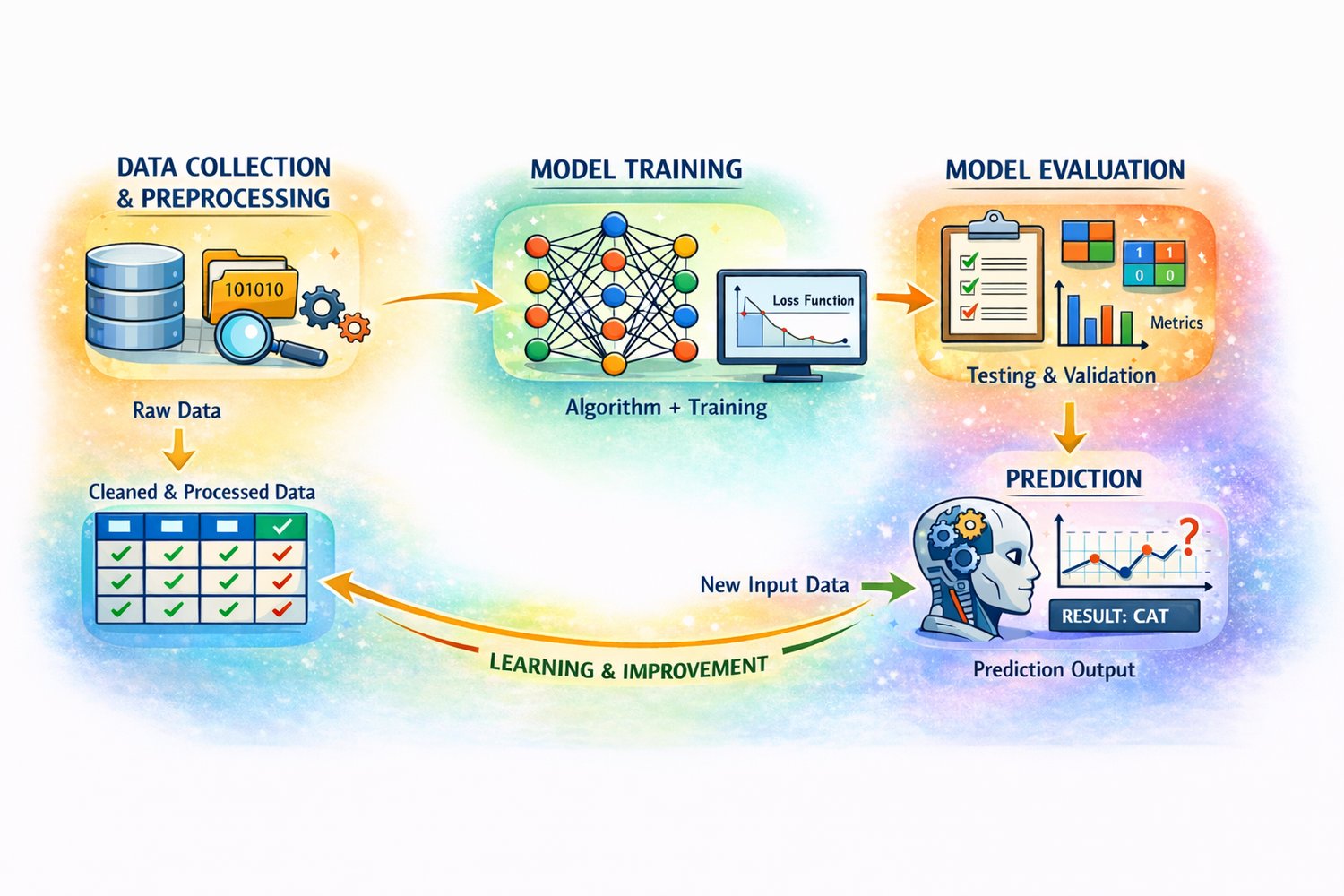
The process of solving a Machine Learning (ML) problem can be systematically approached through the following steps:
1. Study, Understand, and Analyze the Problem.
A. Understand the problem clearly;
B. Identify the type of ML task:
(1). Classification;
(2). Regression;
(3). Clustering;
(4). Reinforcement Learning;
C. Analyze the nature of the data:
(1). Structured data;
(2). Unstructured data;
(3). Time-series data;
(4). Text or categorical data;
D. Choose appropriate performance metrics:
(1). Accuracy;
(2). Precision;
(3). Recall;
(4). F1 Score;
(5). ROC-AUC;
(6). Mean Squared Error (MSE).
2. Data Collection and Understanding.
A. Collect data from multiple reliable sources;
B. Perform exploratory data analysis (EDA):
(1). Understand data distribution;
(2). Identify missing values and outliers;
(3). Investigate relationships between variables.
3. Data Preprocessing.
A. Clean the data:
(1). Remove duplicates;
(2). Handle missing values;
(3). Address outliers and inconsistencies;
B. Transform the data:
(1). Scale numerical features;
(2). Encode categorical variables;
C. Perform feature selection and dimensionality reduction;
D. Split the data into training, validation, and test sets.
4. Model Selection and Building.
A. Select suitable models based on the problem type and data;
B. Common algorithms by task:
(1). Classification – Logistic Regression, Decision Tree, Random Forest, Gradient Boosting, SVM,
Neural Networks.
(2). Regression – Linear Regression, Ridge/Lasso, Decision Trees, Random Forest, Gradient
Boosting.
(3). Clustering – K-Means, DBSCAN, Hierarchical Clustering;
(4). Deep Learning – CNNs, RNNs, Transformers;
C. Train the model using the training set;
D. Tune hyper parameters via Grid Search, Random Search, or Bayesian Optimization;
E. Evaluate model with cross-validation to check for overfitting and stability.
5. Model Improvement.
A. Perform error analysis to identify weak areas;
B. Apply regularization techniques:
(1). L1 (Lasso);
(2). L2 (Ridge);
C. Consider additional feature engineering or collecting more data.
6. Model Testing and Validation.
A. Test the final model on the test dataset;
B. Evaluate using multiple metrics for robustness;
C. Slightly vary input data to ensure generalization.
7. Model Deployment.
A. Deploy the model into a production environment;
B. Use tools like Docker, or platforms like AWS, Azure, GCP;
C. Enable real-time or batch predictions;
D. Monitor model performance for degradation or drift.
8. Process Iteration.
A. Machine Learning is an ongoing iterative process;
B. Continuously update the model with new data and feedback;
C. Revisit and improve earlier steps as needed.